"For most of history, Anonymous was a woman." Virginia Woolf

Friday, October 20, 2006

Crap (a poopy story, for you Craig)

From Wiki: Etymology: The word "crap" is old in the English language, one of a group of nouns applied to discarded cast offs, like "residue from renderings" (1490s) or in Shropshire, "dregs of beer or ale", meanings probably extended from Middle English crappe "chaff, or grain that has been trodden underfoot in a barn" (c. 1440), deriving ultimately from Late Latin crappa, "chaff".

The word fell out of use in Britain by the 1600s, but remained prevalent in the North American colonies which would eventually become the United States. The meaning "to defecate" was recorded in the U.S. since 1846 (according to Oxford and Merriam-Webster), but the word did not hold this meaning at all in Victorian England.

The connection to Thomas Crapper is conjectured by Hart-Davis to be an unfortunate coincidence of his surname. The occupational name Crapper is a variant spelling of Cropper. In the US, the word crapper is a dysphemism for "toilet". The term first appeared in print in the 1930s. It has been suggested that US soldiers stationed in England during World War I (some of whom had little experience with indoor plumbing) saw many toilets printed with "T. Crapper" in the glaze and brought the word home as a synonym for "toilet" — a sort of back-formation from "crap." This suggestion, however, overlooks the fact that "crapper" was a well-established word long before that time.

Yet another purported explanation is that Thomas Crapper's flush toilet advertising was so widespread, and the business name "T. Crapper & Sons, Chelsea," was seen on so many toilets, that "crapper" became a synonym for "toilet" and people simply assumed that he was the inventor.

Many people use the word "dung" rather than crap these days. They use it to hide the slang word and subsitute it for another word. Dung is a more understanding subsitute word for crap because the definition of dung is manure or animal droppings.

Derivative words: crapola, crappy, craptacular, craptastic, craptabulous.

From Online Etymology Dictionary: "defecate" 1846 (v.), 1898 (n.), from one of a cluster of words generally applied to things cast off or discarded (e.g. "weeds growing among corn" (1425), "residue from renderings" (1490s), 18c. underworld slang for "money," and in Shropshire, "dregs of beer or ale"), all probably from M.E. crappe "grain that was trodden underfoot in a barn, chaff" (c.1440), from M.Fr. crape "siftings," from O.Fr. crappe, from M.L. crappa, crapinum "chaff." Sense of "rubbish, nonsense" also first recorded 1898. Despite folk etymology insistence, not from Thomas Crapper (1837-1910) who did, however, in 1882 invent the ball and suction device [British Patent # 4,990] found in modern toilets. The name Crapper is a northern form of Cropper (attested from 1221), an occupational surname, obviously, but the exact reference is unclear.

Bottom (teehee) line: Crap and crapper have two different origins, but have become related words over time.

Thursday, October 19, 2006

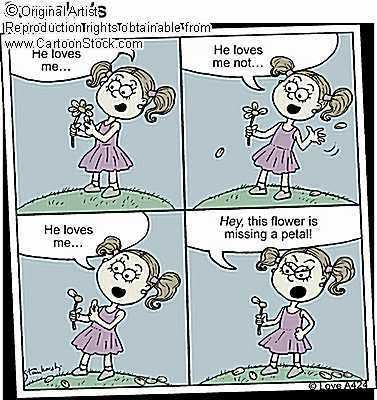
"he loves me, he loves me not.." (a daisy story)


From Wiki: He/She Loves Me, He/She Loves Me Not is a game in which one person (often a child) seeks to determine whether the object of his or her affection returns that affection or not. It is often spoken while plucking the petals of a flower (especially a daisy) one by one, with the last petal giving the "answer" to whether he or she loves you. It is therefore dependent on whether the flower has an even or odd number of petals. It is traditionally performed by a person infatuated with another, and actually seeking to reaffirm a pre-existing belief.
The full expression of "He Loves Me, He Loves Me Not..." in French is: Il / elle m'aime un peu, beaucoup, passionnément, à la folie, pas du tout (He/she loves me a little, a lot, passionately, madly, not at all). This makes the potential outcomes more numerous.

Origins of a Phrase: Unknown exactly, but Goethe's Faust, published in 1808, has the following scene in it:
(
translation from the German:)
MARGARET (half aloud): He loves me—loves me not.
FAUST: Sweet angel, with thy face of heavenly bliss!
MARGARET (continues): He loves me—not—he loves me-not—(Plucking off the last leaf with fond joy.) He loves me!"

Also:
"American Children's Folklore" by Simon J. Bronner (August House Inc., Little Rock, 1988) under "Beliefs and Customs" says:
"To find out how a certain person feels about you, repeat the phrase "He loves me, he loves me not" as you pluck the petals of a daisy. If you take the gold center from the daisy and throw it up in the air, the number of pieces that fall on the back of your hand as you hold it out tells the number of children that you will have."

The FTD site online (2/13/00) says loves me/loves me not is a Victorian custom and elaborates further. On the daisy. Origin & History The daisy derived its English name from the Anglo-Saxon term daes eage, or "day's eye," referring to the way this flower opens and closes with the sun.

The daisy has a facinating history, but this just came to mind, and I thought I'd research it a little.... I also suggest Le Language des Fleurs "The Language of Flowers," published in 1818.

Sunday, July 23, 2006

Paganism [Asatru] gaining popularity in prison

My comments on the below story: I'm sorry if you've had a tough break or know someone that's had a tough break. If they end up in prison and they're heathen, I would not ask them to deny their faith. *However*, this was on the front page of Yahoo when I woke up this morning, and it is also in a Minneapolis newspaper and on ABCnews.com. If this is the only press the heathen community gets in mainstream media, it's bad news for us in general. This line in particular: ""It's a theology that celebrates raw physical power and domination." This is the outside view of our faith? Should we care? Yes. Our names *do* matter outside the heathen community. They matter to our non-heathen family members, our employers, the teachers at our children's schools. We need to *change* this perception. Back to work, hope y'all's myspace's are settling.

Paganism gaining popularity in prison By KRISTEN GELINEAU


A pagan religion that some experts say can be interpreted as encouraging violence is gaining popularity among prison inmates, one of whom is scheduled to be executed this week for killing a fellow prisoner at the foot of an altar.

Michael Lenz is scheduled to die Thursday for the death of Brent Parker, who was stabbed dozens of times at Augusta Correctional Center during a gathering of inmates devoted to Asatru, whose followers worship Norse gods. At his trial, Lenz testified that Parker had not been taking the religion seriously and had to die to protect the honor of the gods.

Other followers call the religion misunderstood and say most adherent inmates do not use it to further violent agendas.

Asatru has been gaining popularity among inmates, say religious leaders and prison experts who believe its roots in Viking mythology attract prisoners seeking power, protection and unity.

The gang culture in prison also contributes, said theologian Britt Minshall, a former police officer and Baltimore pastor who ministers to inmates. Some white inmates who felt threatened by black prison gangs formed their own gangs and sought out a belief system they felt would provide additional security, he said.

"It's a way of grouping together for safety," he said. "And you have to have a god in the middle of that to really keep you safe."

Asatru is often referred to as Odinism, although some followers believe the two are separate religions. It is a polytheistic, pre-Christian faith native to Scandinavia whose adherents worship gods including Thor and Odin.

It emphasizes a connection with one's ancestors and values honor, loyalty, generosity and truth.

An estimated 10,000 to 20,000 people in the United States consider themselves Asatruars or Odinists, said Stephen McNallen, director of the Asatru Folk Assembly, a leading Asatru group.

No national statistics are kept on how many inmates follow Asatru. But experts say its popularity enjoyed a boost from the Supreme Court, which last year sided with an Asatru inmate by upholding a federal law requiring state prisons to accommodate prisoners' religious affiliations.

Asatru is often associated with white supremacy, although most Asatru leaders bristle at suggestions of such a relationship.

A 1999 FBI report on domestic terrorism described Odinism as a "white supremacist ideology that lends itself to violence."

"What makes Odinists dangerous is the fact that many believe in the necessity of becoming martyrs for their cause," the report said.

Such comments are typical of those who don't understand Asatru, said Jane Ruck, who runs the National Prison Kindred Alliance and ministers to Asatru inmates. White supremacists make up only a small portion of Asatruars, and most inmates who follow the religion do not use it to push hate-filled, violent agendas, she said.

"There might be some white supremacists who consider themselves Asatruars, but they're not (Asatruars) because they're not following our beliefs," Ruck said. "We don't hate anybody; we just want to take pride in our heritage."

Lenz and another inmate, fellow Asatruar Jeffrey Remington, stabbed Parker a combined 68 times with makeshift knives. Remington was also sentenced to death but committed suicide in 2004.

According to Art Jipson, who studies white racial extremism and directs the University of Dayton's criminal justice studies program, Lenz's belief that fatal force was warranted is not surprising.

"If he believes the fight was necessary, whether or not it was legal is the least of his concerns," Jipson said. "If he's a truly devout practicing Odinist or Asatruist, he's doing what he must do. And it would be a shame it would be a black mark on his soul, his spirit ... for him to be cowardly and not to fight."

That kind of warrior mentality can exacerbate the tense environment behind bars, said Mark Potok, a leader at the Southern Poverty Law Center in Montgomery, Ala., which monitors hate groups.

"It's a theology that celebrates raw physical power and domination, and that is why I think it is so popular among prison inmates," Potok said. "The kind of inmate who might be attracted to this is a white man who is looking for justification for extreme violence, who is looking for an ideology which explains why he should be the boss."

[Edit:

7/24-Comment from Craig: Lentz is a homicidal killer, a prisoner and an outlaw. The Gods do not recognize such people. They are "Nithing". I have never had anything to do with "prison ministries" because of the outlawry of people in prison. Our society has declared them outlaw and that is why they are in prison in the first place. I think that Asatru should as a group condem unlawful acts of all sorts. And abide by the desisions of judges when it comes to these outlaws. They have been banished from our people for a reason. Those that go hanging out with them are misguided. After a prisoners banishment has ended they should be welcomed back into society. But not before hand. I know that prison is not at all like the banishment of the past. And that prisoners should have some contact with the outside world so not to become compleatly consumed by "prison life". I have sat and talked man to man with Mark Potok from the SPLC about this several years ago. He and others realize that not all asatru are like these outlaws. He knows that many of us are normal healthy law abideing citizens. They know that many of us just want to practice our beliefs and be pretty much left alone. But that story doesn't sell toothpaste and chevrolets! Personally I think that the actions of such criminals as Lenz should be loudly, publicly, and unilateraly condemed by the greater Asatru community. But they won't do it. It might mean actually standing up for something that makes a difference. Most would like to play at being the big shot of their little fifedom of their own imagination. Michael lenz should be exicuted and buried with out a marker. All records of his existance should be sealed and his name should never be spoken again, for his nithingness.

7/26-Comment from Bodi: Ok....done. Here is the email that I just sent off to Ms. Gelineau:
Dear Ms. Gelineau,

I would like to correspond with you about the article that you wrote on Asatru in American prisons, in connection with this Lenz person that has once again dragged our collective good name through the mud of the media. I would like to reiterate some of the positive things said in the article:

"It emphasizes a connection with one's ancestors and values honor, loyalty, generosity and truth."

**This is absolutely true, and this is how we present ourselves to the general public. How can one possibly come to the conclusion that one should do drugs, murder people, and wind up in prison from that?

"There might be some white supremacists who consider themselves Asatruars, but they're not (Asatruars) because they're not following our beliefs," Ruck said. "We don't hate anybody; we just want to take pride in our heritage."

**This is also an accurate statement, but I'd like to delve a little deeper on the subject. These sick individuals who co-opt our faith in order to further their own socio-political agendas, be they in prison or not, ARE NOT MEMBERS OF OUR FAITH, no matter what they claim or profess. Members of white supremacist groups seek to place the blame for their own shortcomings and what they perceive to be the shortcomings of all European Americans on other peoples, be they black, hispanic, jewish, etc., but the fact of the matter for us is this: We do not have to hate others to love ourselves, our heritage, and our Faith. In fact, it is an imperative within the greater Asatru community that hate has no place in our Faith. None at all. We simply seek to live our lives in peace and continue to rebuild the rich, vibrant faith that our European ancestors bequeathed to us.

**And now for the misinformation and outright lies:

"If he believes the fight was necessary, whether or not it was legal is the least of his concerns," Jipson said. "If he's a truly devout practicing Odinist or Asatruist, he's doing what he must do. And it would be a shame it would be a black mark on his soul, his spirit ... for him to be cowardly and not to fight."

**If I might be candid for a moment...I question Mr. Jipson's research and basis for this entire statement. No where in the teachings of our Faith will you find any reference or mandate stating that when one is faced with a decision to fight or not, that failure to fight will cause a black mark on one's spirit or soul. This is absurd and would be laughable, had Mr. Jipson's misguided and unfounded statements not been posted on the internet for the entire world to be misled by them. Unless Mr. Jipson is himself a devout practicing Odinist/Asaturar(correct conjugation, not Asatruist), or personally knows a broad cross section of the Asatru community, I respectfully suggest that he refrain from making such statements in public, and that you, the Associated Press, or any other news agency do better research on the matter.

"A 1999 FBI report on domestic terrorism described Odinism as a "white supremacist ideology that lends itself to violence."
"What makes Odinists dangerous is the fact that many believe in the necessity of becoming martyrs for their cause," the report said."

** Again, where are the facts and solid research to back these statements? Asatru itself has had no ties, nor will it have, to white supremacist ideology, and our faith does not lend itself to violence. Would I personally be willing to die for my faith? Yes, I would. However, I do not believe it to be a necessity that I must put forth as a main tenet of our faith, because it is not one of them.

In the interest of not making this a fifteen page email, I will sum this up by saying that you have been fed gross amounts of misinformation about Asatru and it's adherants, and I respectfully ask that you take the initiative to seek the truth and post it for the world to see. I would like to assist you in that endeavour, and look forward to your reply.

-Bodi Mayo-
Savannah, Georgia]

Friday, July 14, 2006

Reply to a NineWorlds question re: use of ochre

Question on NineWorlds from Vedis was:

Anyone know the significance of Ochre, and why it was placed in the graves of our ancestors? Also, anyone know of a good place to purchase the stuff?


My research/response:

I'm not sure if the ochre material itself was significance or it was the color/pigment of the ochre that was important. In theory, ochre could've have just been the easiet material early man found it could use for such a purpose. The 'ochre burial ritual' is quite possibly over 100,000 years old. It was one of the oldest pigments/materials used by human beings (and before that by Neanderthals) in burial rituals or cave paintings. Evidence of its use is found on several continents during a variety of eras and has not necessarily been native to all of the areas.

Two articles re: 100k yr old ochre use:

http://news.bbc.co.uk/2/hi/science/nature/3310233.stm

--"The red ochre meant something to them, exactly what we do not know, but it is not inconceivable that they painted their dead with red ochre," says Erella Hovers. "It is an example of symbolic thought, the ochre symbolised death. The humans at this time behaved in a way that was not just functional but symbolic as well," she added. [My note: I've also heard it speculated that ochre use symbolized life or the afterlife]

More recently, in Denmark 6500 yrs ago, a man was found with red ochre scattered around his head. http://museums.ncl.ac.uk/flint/archrit.html

I would love to get my hands on this article: M. Porr and K.W. Alt, The burial of Bad Dürrenberg, Central Germany: osteopathology and osteoarchaeology of a Late Mesolithic shaman's grave, International Journal of Osteoarchaeology, 2006.

----The abstract mentions that within the grave was a piece of red ochre and split roe deer metatarsus that was probably used to apply the pigment. On various other websites found through googling, there were multiple mentions of deer bones or antlers being covered in ochre and placed in graves. http://www.spoilheap.co.uk/burintr.htm also mentions the specific use of red ochre on the face or around the skull. It seems to be used on both adults and children in the Paleolithic age. (Also see: http://www.athenapub.com/8zilhao1.htm). Red ochre has also been used in ritual animal burial ( http://home.entouch.net/dmd/religion.htm ).

I found this thread:http://forum.skadi.net/showthread.php?t=20963 to which someone has posted an introduction to a book _Cities of Dreams: When Women Ruled the Earth_ by Stan Gooch. It was some interesting points on the use/mining of red ochre, but I don't know how good the research is because there is no bibliography/footnotes.

http://www.iconofile.com/storefront.asp?page=Ochre

is an online catalog where you can purchase various colors of ochre.

http://www.mccallisters.com/index.php/cPath/202 is another

http://web2.jns.fi/punamult/english/redtext.htm is a recipe for ochre paint.

So maybe it's the red pigment that meant something to them, maybe it was somehow connected to the ritual use of beer bones/antlers, maybe the actual ochre material coming from the earth as it did symbolized something to them...

Reply to a NineWorlds question re: use of ochre

Question on NineWorlds from Vedis was:

Anyone know the significance of Ochre, and why it was placed in the graves of our ancestors? Also, anyone know of a good place to purchase the stuff?

My research/response:

I'm not sure if the ochre material itself was significance or it was the color/pigment of the ochre that was important. In theory, ochre could've have just been the easiet material early man found it could use for such a purpose. The 'ochre burial ritual' is quite possibly over 100,000 years old. It was one of the oldest pigments/materials used by human beings (and before that by Neanderthals) in burial rituals or cave paintings. Evidence of its use is found on several continents during a variety of eras and has not necessarily been native to all of the areas.

Two articles re: 100k yr old ochre use:

http://news.bbc.co.uk/2/hi/science/nature/3310233.stm

--"The red ochre meant something to them, exactly what we do not know, but it is not inconceivable that they painted their dead with red ochre," says Erella Hovers. "It is an example of symbolic thought, the ochre symbolised death. The humans at this time behaved in a way that was not just functional but symbolic as well," she added. [My note: I've also heard it speculated that ochre use symbolized life or the afterlife]

More recently, in Denmark 6500 yrs ago, a man was found with red ochre scattered around his head. http://museums.ncl.ac.uk/flint/archrit.html

I would love to get my hands on this article: M. Porr and K.W. Alt, The burial of Bad Dürrenberg, Central Germany: osteopathology and osteoarchaeology of a Late Mesolithic shaman's grave, International Journal of Osteoarchaeology, 2006.

----The abstract mentions that within the grave was a piece of red ochre and split roe deer metatarsus that was probably used to apply the pigment. On various other websites found through googling, there were multiple mentions of deer bones or antlers being covered in ochre and placed in graves. http://www.spoilheap.co.uk/burintr.htm also mentions the specific use of red ochre on the face or around the skull. It seems to be used on both adults and children in the Paleolithic age. (Also see: http://www.athenapub.com/8zilhao1.htm). Red ochre has also been used in ritual animal burial ( http://home.entouch.net/dmd/religion.htm ).

I found this thread:http://forum.skadi.net/showthread.php?t=20963 to which someone has posted an introduction to a book _Cities of Dreams: When Women Ruled the Earth_ by Stan Gooch. It was some interesting points on the use/mining of red ochre, but I don't know how good the research is because there is no bibliography/footnotes.

http://www.iconofile.com/storefront.asp?page=Ochre

is an online catalog where you can purchase various colors of ochre.

http://www.mccallisters.com/index.php/cPath/202 is another

http://web2.jns.fi/punamult/english/redtext.htm is a recipe for ochre paint.

So maybe it's the red pigment that meant something to them, maybe it was somehow connected to the ritual use of beer bones/antlers, maybe the actual ochre material coming from the earth as it did symbolized something to them...

Wednesday, May 3, 2006

The music I've been listenin' to:

Long Ride Home, Patty Griffin... I really like Patty Griffin...

Long, black limousine
Shiniest car I've ever seen
The back seat is nice and clean
She rides as quiet as a dream

Someone dug a hole six long feet in the ground
I said good-bye to you and I threw my roses down
Ain't nothin' left at all in the end of bein' proud
With me ridin' in this car and you flyin' through them clouds

I've had some time to think about it
And watch the sun sink like a stone
I've had some time to think about you
On the long, ride home

One day I took your tiny hand
Put your finger in the wedding band
Your daddy gave the piece of land
We made ourselves the best of plans

Forty years go by with someone layin' in your bed
Forty years of things you say, you wish you'd never said
How hard would it have been to say some kinder words instead
I wonder as I stare up at the sky a turnin' red

I've had some time to think about it
And watch the sun sink like a stone
I've had some time to think about you
On the long, ride home

Headlights searchin' down the driveway
The house is dark as it can be
I go inside and all is silent
And seems as empty as the inside of me

I've had some time to think about it
And watch the sun sink like a stone
I've had some time to think about you
On the long, on the long, on the long, ride home